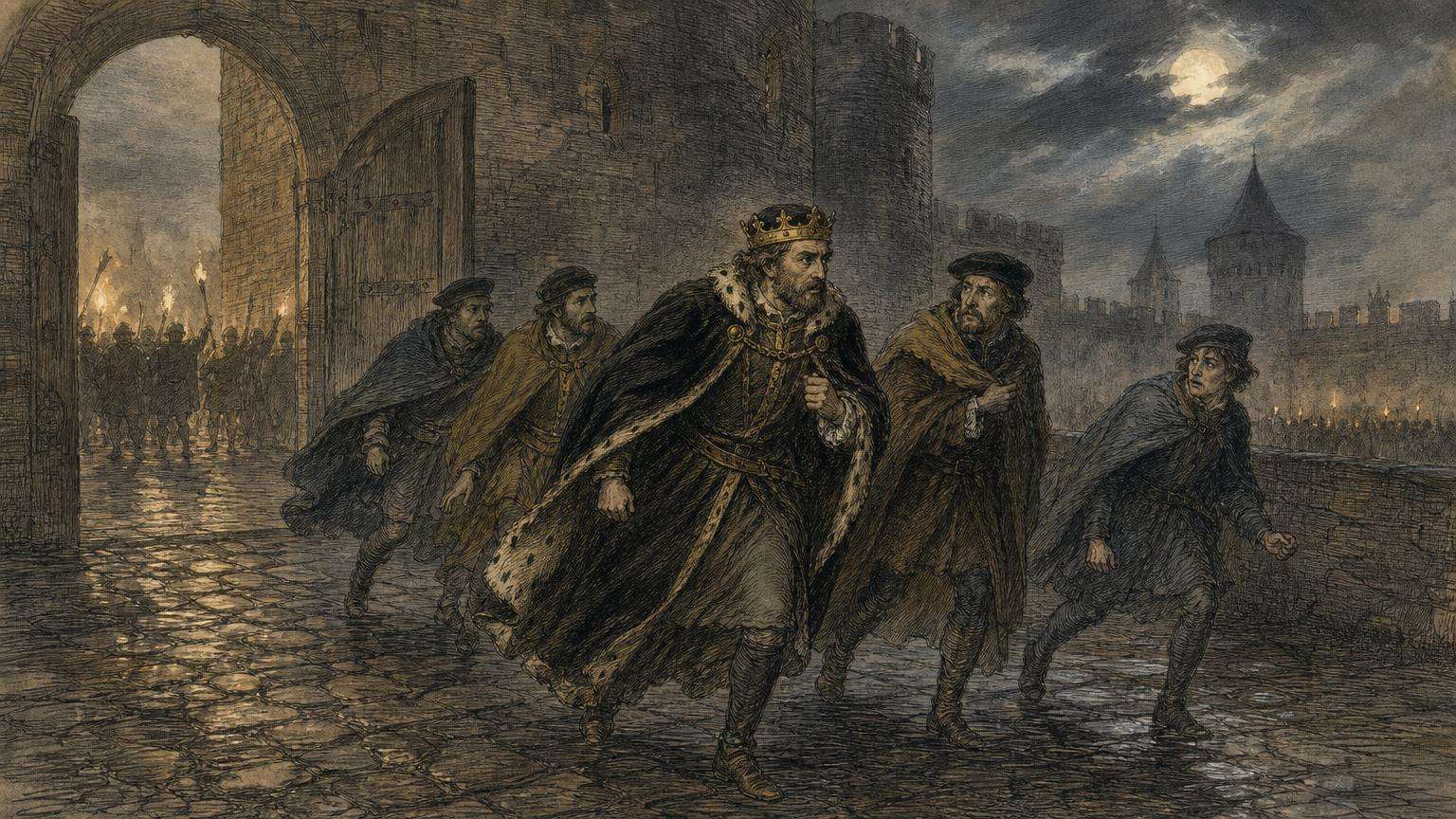
The Night the King Fled the King's Court
Králodvorská
After the death of Jan of Rokycany new religious quarrels arose, and when several Utraquist priests much loved by the people were arrested in 1480, the quarrels did not cease. Then, when word spread that the councillors treacherously meant to do away with the men of the opposing party, the communities of the Old, New and Lesser Towns rose up, and on 24 September 1483 the hated councillors were mostly seized and killed in the town halls. Only a few escaped safely, and later returned to Prague with King Vladislaus, moving among the courtiers, it is said, in masks so that the people should not know them. Yet one of them was recognised — Vít Ocásek the smith, a man greatly hated by the people. He did escape his pursuers into the King's Court, but the crowd beat on the gate with great shouting and din and cried: “Give us those traitors who should have been beheaded before; if you do not, we shall tear this court down and the king with it.” The king, seeing and hearing what was happening, was tormented by great fear and did not so much as look out of a window. Then Lord Ješek Svojanovský of Bozkovice, himself an Utraquist and popular with the people, had a side postern opened, rode out among the crowd and calmed them with fair words, begging them earnestly not to set about such things against the king, their lord. At this a tailor named Bonuš is said to have shouted: “Give us that Polish king too, the enemy!” And Lord Svojanovský looked round at him and said: “Good youth, a pity for your years and your looks that you would be executioner over your own lord; be silent! And if this king were to perish now by your hands, perhaps a future king would remember it against you.” When the people had been soothed by this gracious admonition and by the promise that Ocásek and any other traitors would go to the town prison, and had begun to disperse, the king sat utterly terrified in the outermost wing of his palace beside the new tower and looked through the window across the moat at the New Town. And then, from the house opposite that tower, later called U Ledvinků, a New Town neighbour, the smith Martin Marjánek, ran out to the very edge of the moat with a great crossbow, drew his bow and is said to have aimed at the king, crying: “Give us those traitors! Kill that king, the imported Pole!” The king was appalled and ordered preparations for removal at once; that evening he walked with a small number of courtiers to the end of the moats and had himself ferried across to the other bank. And the next day in the church of Saint Vitus he swore that he would hold court in Prague no longer. So Hájek tells it, more or less — and although much in it is certainly invented, this much is true, that the king did then move with his court to the castle and garrison it. From that time the King's Court fell into decay, and its royal age was over.